An engineering deep-dive for logistics directors and structural procurement teams on calculating Uniformly Distributed Loads (UDL), deflection limits ($L/180$), and seismic safety coefficients.
Understanding Pallet Rack Beam Capacity: The Structural Physics of Warehouse Safety
In modern industrial logistics, calculating pallet rack beam capacity is not simply a matter of selecting a random pair of horizontal steel bars. It is a critical structural engineering discipline dictated by strict governing standards such as ANSI MH16.1 (published by the Rack Manufacturers Institute - RMI) and AISI S100 (Specification for the Design of Cold-Formed Steel Structural Members).
At CR Industrial Racks & Storage Co., we design selective step beams and heavy-duty structural C-channel load beams based on the principle of Uniformly Distributed Load (UDL). A common misconception among international procurement agents is that beam capacity specifies maximum concentrated point loads. In engineering reality, published rating charts assume that the weight of two or three pallets is evenly distributed across the entire horizontal clear span length of the beam pair.
Calculating the true safety margin of a pallet rack beam requires examining the section modulus ($S$), moment of inertia ($I$), steel yield strength ($F_y$), connector pin shear strength, and allowable vertical deflection limits. When you source racking systems from CR Industrial Racks & Storage Co., every single beam profile is engineered, batch-tested, and stamped to guarantee structural predictability under maximum rated capacity.
RMI compliance across all step & structural beam profiles
Engineering Fundamentals
How Pallet Rack Beam Capacity Is Calculated & Standardized
Explore the fundamental mechanics governing horizontal beam deflection, flexural stress, and connector dynamics.
Uniformly Distributed Load (UDL)
Beam load ratings assume two or three pallets resting across the full span, exerting symmetric downward pressure. Concentrated or off-center point loads reduce total rated capacity by 30% to 50% due to localized flexural stress peaks.
RMI Standard Load
The $L/180$ Deflection Rule
The maximum vertical sag allowable under full rated payload is $L/180$ (Clear Span Length divided by 180). For an 8-foot (96-inch) beam span, maximum visual deflection must not exceed 0.533 inches (13.5 mm). Exceeding this limit causes permanent plastic deformation.
Deflection Threshold
Step Beams vs. Structural Channels
Roll-formed step beams feature a 1-5/8" step ledge designed to securely hold wire decking and cross bars. Structural C-channel beams, hot-rolled from heavy structural steel, provide extreme torsional resistance against impact damage.
Profile Geometry
End Connectors & Safety Pins
Beam capacity depends heavily on the beam-to-column connection. End plates with 3-hook or 4-hook configurations distribute bending moments into upright columns, while automatic safety locking pins prevent accidental forklift dislodgements.
Connector Shear Force
Technical Reference
Standard Pallet Rack Beam Capacity Reference Chart
The table below details standard roll-formed step beam profiles, clear spans, section properties, and maximum allowable load capacities per pair based on Uniformly Distributed Load (UDL) ratings compliant with RMI standards.
Beam Clear Span
Beam Profile Depth
Steel Material Gauge
Max Capacity Per Pair (UDL)
Max Deflection at Cap ($L/180$)
Recommended Application
96 inches (8 ft / 2,438 mm)
3.50 inches (89 mm)
16 Gauge (0.059 in)
4,100 lbs (1,860 kg)
0.533 inches (13.5 mm)
Light-to-Medium Pallet Loads / Split-Case Picking
96 inches (8 ft / 2,438 mm)
4.12 inches (105 mm)
15 Gauge (0.067 in)
6,000 lbs (2,721 kg)
0.533 inches (13.5 mm)
Standard Dual-Pallet Storage (3,000 lbs/pallet)
96 inches (8 ft / 2,438 mm)
5.00 inches (127 mm)
14 Gauge (0.075 in)
8,200 lbs (3,719 kg)
0.533 inches (13.5 mm)
Heavy Industrial & Cold Storage Stacking
108 inches (9 ft / 2,743 mm)
4.12 inches (105 mm)
15 Gauge (0.067 in)
5,100 lbs (2,313 kg)
0.600 inches (15.2 mm)
Standard Dual-Pallet Wide Storage (48" x 40" Pallets)
108 inches (9 ft / 2,743 mm)
5.00 inches (127 mm)
14 Gauge (0.075 in)
7,400 lbs (3,356 kg)
0.600 inches (15.2 mm)
High-Density Grocery & Chemical Storage
120 inches (10 ft / 3,048 mm)
5.50 inches (140 mm)
14 Gauge (0.075 in)
7,000 lbs (3,175 kg)
0.666 inches (16.9 mm)
Triple-Pallet Storage (Light/Medium SKU Mix)
144 inches (12 ft / 3,658 mm)
6.00 inches (152 mm)
12 Gauge (0.105 in)
8,500 lbs (3,855 kg)
0.800 inches (20.3 mm)
Extra-Wide Triple Pallet Bay / Bulk Freight
Structural C3" Channel (8 ft)
3.00 inches Structural Steel
Hot Rolled 4.1 lb/ft Structural
7,200 lbs (3,265 kg)
0.533 inches (13.5 mm)
High-Impact Distribution & Heavy Manufacturing
Structural C4" Channel (9 ft)
4.00 inches Structural Steel
Hot Rolled 5.4 lb/ft Structural
9,800 lbs (4,445 kg)
0.600 inches (15.2 mm)
Extreme Payload, Freezing Plants & Heavy Metals
*Note: Capacities listed reflect a pair of beams carrying a Uniformly Distributed Load (UDL). Point loading, impact loading, or missing safety locking pins significantly alter real-world structural performance. Contact [email protected] for project-specific engineering calculations.
70 Years HeritageEngineered beam structural design
Enterprise E-E-A-T & Trustworthiness
Nearly 70 Years of Precision Engineering Heritage in Racking Manufacturing
When calculating pallet rack beam capacity, structural experience matters. CR Industrial Racks & Storage Co. brings nearly seven decades of industrial manufacturing heritage, partnering with global Fortune 500 logistics firms, cold storage operators, and regional supply chain hubs across Central America and North America.
Our engineering team does not rely on generic load assumptions. Every beam profile is evaluated under finite element analysis (FEA), verifying torsional stability, web crippling resistance, and connector hook engagement under both static gravity loading and dynamic seismic forces.
Full engineering certification compliant with RMI / ANSI MH16.1 standards
Bilingual technical documentation (English & Spanish) for global compliance
Seamless integration with seismic requirements such as the Código Sísmico de Costa Rica
Multi-Million-Dollar Powder Coat Lines: Finish Integrity for Harsh Climates
Structural beam capacity isn't just about steel thickness—it's also about long-term material integrity. High humidity, coastal salt exposure, or extreme cold storage moisture can cause micro-corrosion, compromising weld joints and reducing effective beam section thickness over time.
CR Industrial Racks & Storage Co. operates multi-million-dollar automated powder coating paint lines. This state-of-the-art process electrostaticly coats every step beam, structural channel, and connector clip with an exceptionally durable powder barrier that resists chemical erosion, chipping, and humidity-induced oxidation.
Forklift impact is the primary operational hazard to pallet rack beam load capacity. Upward force from a lifting forklift can dislodge a beam if safety locking pins are damaged or missing, leading to catastrophic bay collapse.
At CR Industrial Racks & Storage Co., our step beams feature patented, high-shear safety locks that automatically engage upon installation. We also provide heavy-duty straddle column protectors, tie-bars, and engineered rack repair kits to keep your beam-and-upright system structurally sound for decades.
Future Procurement & Development Trends in Pallet Rack Beam Technology
How automation, advanced metallurgy, and real-time sensor analytics are redefining pallet rack beam specifications for global logistics hubs.
High-Yield Ultra-High-Strength Steel (UHSS)
Future beam designs utilize high-strength cold-rolled micro-alloyed steel. By increasing yield strength from 33,000 PSI to over 60,000 PSI, manufacturers can reduce raw steel weight while increasing net payload capacity, lowering container freight costs.
Metallurgy Advances
AS/RS & Zero-Deflection Tolerances
As warehouse automation grows, Autonomous Mobile Robots (AMRs) and Automated Storage and Retrieval Systems (AS/RS) demand ultra-strict beam deflection limits—tightened from standard $L/180$ to $L/300$ or $L/400$—to ensure robotic shuttle sensors can align accurately.
Automation Compatibility
IoT Structural Health Monitoring
Emerging smart warehouse standards embed optical or strain-gauge sensors inside load beams. These IoT sensors continuously measure real-time deflection and send instant alerts if a bay is overloaded beyond rated UDL thresholds.
Smart Rack Analytics
ESG & Decarbonized Steel Sourcing
Global procurement teams are prioritizing green supply chains. CR Industrial Racks & Storage Co. aligns with sustainable steel mill production, using recyclable steel and eco-friendly zero-VOC powder coat lines to reduce Scope 3 embodied carbon.
Sustainable Procurement
Product System Selection
High-Capacity Racking Systems Engineered for Global Logistics
Match your specific SKU density, pallet weight requirements, and building envelope to our engineered racking solutions.
01
Selective Pallet Rack Beams
Standard roll-formed step beams engineered for 100% selectivity. Fits all standard wire mesh decking, cross bars, and pallet sizes.
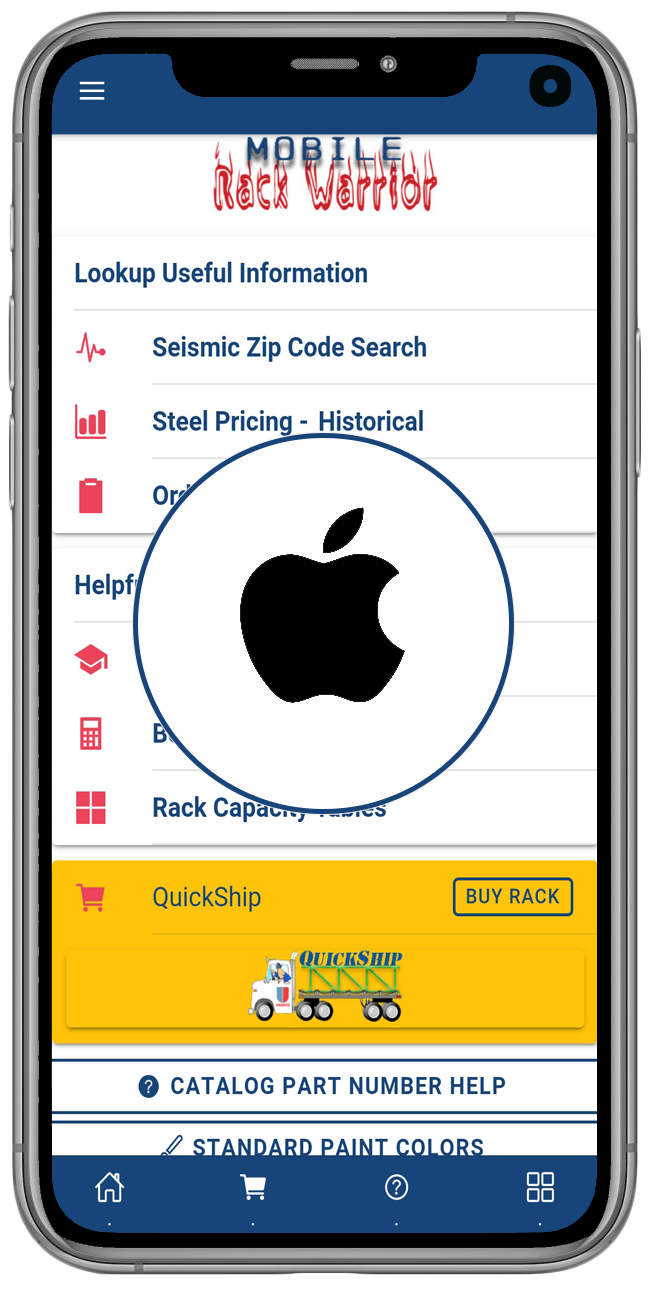
Calculate pallet rack beam capacity, verify maximum vertical deflection ($L/180$), access RMI engineering tables, and lookup seismic parameters directly from your tablet or smartphone on the warehouse floor.
Instant beam capacity calculator (UDL)
Upright column load frame tables
Seismic zone parameter lookup
Assembly & safety lock verification
Glossary of structural racking terms
Powder coat color & finish guides
Search "Mobile Rack Warrior" in your mobile application store.
Detailed technical answers for warehouse safety managers, structural engineers, and logistics buyers.
How is pallet rack beam capacity calculated?
Pallet rack beam capacity is determined per pair of beams assuming a Uniformly Distributed Load (UDL) based on ANSI MH16.1 specifications published by the Rack Manufacturers Institute (RMI). The calculation evaluates maximum bending moment, section modulus ($S$), material yield strength ($F_y$), and maximum allowable vertical deflection, capped at $L/180$ (clear span length divided by 180).
What is the L/180 deflection rule for pallet rack beams?
The $L/180$ deflection rule specifies that under full design payload, a loaded horizontal beam pair must not flex downward by more than the clear span length divided by 180. For instance, a standard 96-inch (8-foot) beam span must not deflect more than 0.533 inches (13.5 mm). Controlling deflection prevents permanent steel deformation, beam-to-frame unhooking, and pallet instability.
Does published beam capacity apply to a single beam or a pair?
In standard material handling and warehouse racking engineering terminology, published beam capacity tables ALWAYS specify the combined weight capacity supported by a PAIR of beams (front beam and rear beam) for a single shelf level, assuming uniform weight distribution.
How do point loads or concentrated loads affect beam safety limits?
Point loads or non-uniform point contacts concentrate heavy weight at specific points along the beam profile rather than distributing it evenly. A beam pair loaded with concentrated point loads can experience up to a 50% reduction in effective load capacity compared to its rated Uniformly Distributed Load (UDL). Pallet support bars or wire decking must be added to distribute concentrated forces across the beam step.
How do seismic zones (e.g., Costa Rica) impact beam and end connector selection?
In high-seismicity regions like Costa Rica, lateral ground motion generates intense cyclic stress, shear forces, and vertical accelerations. Beams must feature heavy-duty 3-hook or 4-hook end connector plates welded to the beam profile, paired with high-tensile safety locking pins to withstand dynamic seismic uplift forces and prevent unhooking under structural sway (per the Código Sísmico de Costa Rica).
Can you mix step beams and frames from different racking manufacturers?
Mixing components from different manufacturers is strongly discouraged by RMI standards and voids structural load warranties. Minor variances in hook plate thickness, hole teardrop pitch, steel yield strength, and connector tolerances can cause uneven load distribution, localized stress concentration, and potential structural failure.
What finish works best for load beams in cold storage and high humidity?
Automated powder coating provides an exceptional barrier against moisture and corrosion in humid tropical warehouses or cold storage freezers. For extreme coastal environments exposed to salt air (such as port facilities in Limón or Puntarenas), hot-dip galvanized or specialized zinc-rich primer finishes can be specified during the engineering design phase.
Need Custom Pallet Rack Beam Capacity Calculations?
Our structural engineers will analyze your load profiles, building layout, and seismic requirements to provide certified rack capacity specifications.