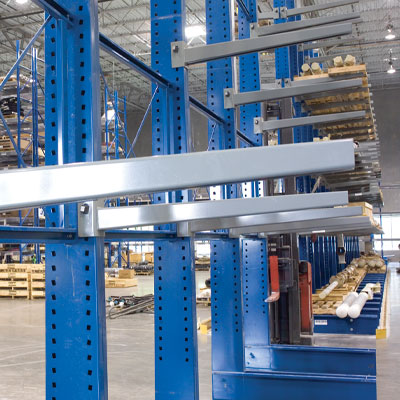
Structural Steel Cantilever
Fabricated from hot-rolled I-beams (WF shapes). Rated for capacities exceeding 15,000 lbs per arm. Ideal for steel mills, rebar yards, and heavy pipe storage.
Precision structural steel cantilever racking engineered for uncompromised load capacities, seismic safety compliance, and maximum storage density for lumber, steel piping, rebar, and oversized material handling.
In modern industrial logistics, storing long, bulky, or non-standard materials—such as structural steel beams, aluminum extrusions, PVC piping, bundled timber, and heavy industrial tubing—presents unique engineering challenges. Traditional pallet racking systems with front vertical columns restrict horizontal loading, making long item handling inefficient and unsafe. CR Industrial Racks & Storage Co. designs and manufactures heavy-duty cantilever storage systems that eliminate front column interference, offering unobstructed horizontal linear storage and maximum material handling efficiency.
Every cantilever rack produced by CR Industrial Racks & Storage Co. strictly adheres to RMI (Rack Manufacturers Institute) and ANSI MH16.3 standards. Engineered from high-strength ASTM A572 Grade 50 structural steel or heavy-gauge roll-formed steel, our cantilever systems feature load-tested moment connections, rigid tower bracing, and mathematically calculated arm taper geometries to eliminate dangerous deflection, stress concentrations, and structural fatigue during heavy loading.
Contact UsWhether you require lightweight roll-formed cantilever racking for light tubing or massive hot-rolled I-beam structural cantilever systems for heavy steel service centers, CR Industrial Racks & Storage Co. delivers certified, precision-engineered equipment.
Fabricated from hot-rolled I-beams (WF shapes). Rated for capacities exceeding 15,000 lbs per arm. Ideal for steel mills, rebar yards, and heavy pipe storage.
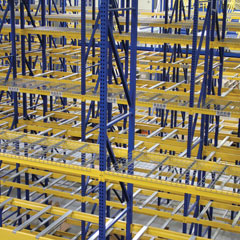
Cost-effective C-channel profile for medium-duty lumber, plastic extrusion, and furniture storage with adjustated 3-inch center arm positioning.
Hot-dip galvanized (HDG) structural cantilever with integrated roof canopy trusses engineered to resist severe coastal salt air, rain, and lateral wind loads.
Maximizes warehouse aisle efficiency by balancing load moments across a central structural column. Engineered for narrow-aisle side-loader forklifts.
Combines cantilever arm versatility with steel mesh or solid plate decking, allowing variable-length items and crates to be safely stored without sagging.
Compare structural load parameters, material grades, and arm connections to select the proper cantilever configuration for your facility.
| Feature / Parameter | Light-Duty Roll-Formed | Medium-Duty Structural | Heavy-Duty Structural I-Beam | Ultra-Heavy Galvanized Yard |
|---|---|---|---|---|
| Typical Load Range (Per Arm) | 500 – 1,500 lbs (225 – 680 kg) | 1,500 – 4,000 lbs (680 – 1,810 kg) | 4,000 – 12,000 lbs (1,810 – 5,440 kg) | 12,000 – 20,000+ lbs (5,440 – 9,070+ kg) |
| Column Height Range | 8 ft – 16 ft (2.4m – 4.8m) | 12 ft – 20 ft (3.6m – 6.0m) | 12 ft – 30 ft (3.6m – 9.1m) | 16 ft – 36 ft (4.8m – 11.0m) |
| Arm Incline Angle Options | Straight (0°) or 2° Incline | Straight (0°), 2° or 4° Incline | Straight (0°), 2°, 3° or 4° Incline | Custom Tapered with End Stops |
| Steel Fabrication Standard | ASTM A1011 Cold-Rolled Strip | ASTM A36 / A572 Structural | ASTM A572 Grade 50 I-Beam | Hot-Dip Galvanized Structural Steel |
| Arm-to-Column Connection | Pin Key or Keyhole Boltless | Heavy Hex Bolt-on Connection | 4-Bolt High-Tensile Flange Mount | Heavy Pin & Plate Shear Lock |
| Recommended Load Types | Light molding, conduit, carpet roll | Lumber bundles, PVC pipe, plywood | Structural beams, steel plate, rebar | Heavy timber, oilfield pipe, marine gear |
The cardinal rule of cantilever storage engineering is that cantilever arms are rated on a Uniformly Distributed Load (UDL) based on a fixed Load Center. The load center is defined as exactly half the usable length of the arm (L/2). Placing a load further out toward the tip increases the overturning bending moment ($M = F \times d$), exponentially reducing the safe load-carrying capacity of both the arm and the supporting column tower.
Engineers at CR Industrial Racks & Storage Co. calculate arm deflection ratios to ensure they do not exceed $L/180$, preventing permanent plastic deformation of the steel and ensuring easy loading and unloading with side-loaders or overhead cranes.
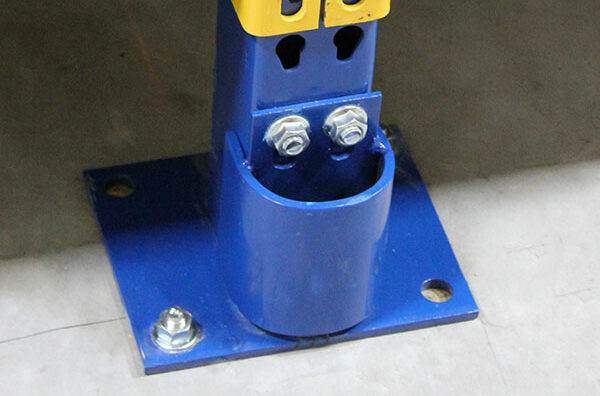
Unlike standard 4-post pallet racking where loads are distributed across four vertical legs, a cantilever column functions as an unbraced vertical structural cantilever fixed at its base plate. Under seismic acceleration—such as conditions encountered in high-seismicity regions like Costa Rica or coastal Latin America—tremendous overturning lateral moments ($M_0$) are concentrated directly at the base connection and floor slab anchors.
CR Industrial Racks & Storage Co. designs structural cantilever base plates with heavy welded gussets, extended anchor bolt patterns, and high-embedment wedge anchors. Our structural team collaborates directly with local engineers to verify concrete slab thickness and compressive strength ($f'c \ge 3,000\text{ PSI}$ or $21\text{ MPa}$), ensuring absolute structural stability under both static dead loads and dynamic lateral earthquake forces.
Contact UsAs global supply chains modernize, material handling infrastructure is undergoing rapid technological and architectural shifts. Procurement teams must account for four major industry trends when designing long load storage systems.
Driven by skyrocketing warehouse land costs, facilities are integrating cantilever towers onto heavy-duty motorized mobile carriages on steel floor tracks. This eliminates static aisles and increases long-item volumetric storage density by up to 85%.
High-Density StorageIndustrial distributors are increasingly utilizing outdoor yard spaces by purchasing structural cantilever systems fitted with roof trusses and back cladding. This converts open yard real estate into covered storage without full building permit costs.
Outdoor EfficiencyModern cantilever systems are engineered with magnetic guide rails or optical aisle guidance systems to seamlessly integrate with automated guided vehicles (AGVs) and specialized multidirectional side-loader forklifts.
Automation ReadyWith global climate volatility and tropical coastal expansion, hot-dip galvanizing (HDG) per ASTM A123 is replacing standard paint for heavy industrial cantilever storage, ensuring 30+ year rust-free operational lifespans.
Long-Term DurabilityBacked by nearly 70 years of structural rack manufacturing heritage, CR Industrial Racks & Storage Co. provides uncompromised engineering rigor, certified material quality, and turnkey project delivery.
Decades of specialized steel fabrication experience ensuring every column section, arm lip, and brace tower meets rigid structural safety margins.
Multi-million-dollar finishing lines deliver uniform, high-durability epoxy powder coat or hot-dip galvanized finishes suited for severe tropical humidity.
Every cantilever storage component is structural-engineer-stamped and designed in accordance with current ANSI MH16.3 racking standards.
Full container loading, ocean freight routing, export documentation, and on-site engineering supervision from project initiation to final commissioning.
Direct answers to complex engineering and procurement queries frequently asked by warehouse operations directors and structural engineers.
Cantilever storage arm capacity is mathematically determined based on a Uniformly Distributed Load (UDL) with the load center ($LC$) positioned at $L/2$ (half the arm's usable length). If a 48-inch arm is rated at 3,000 lbs, that rating assumes the load's center of gravity is positioned at 24 inches from the face of the column tower.
If the material load center shifts further toward the tip (e.g., concentrated at 36 inches), the bending moment ($M = F \times d$) increases by 50%, thereby reducing the safe working capacity of the arm to 2,000 lbs. Always consult CR Industrial Racks & Storage Co.'s load capacity tables or consult our engineering team at [email protected] before storing non-uniform or offset loads.
Roll-formed cantilever systems are cold-formed from sheet steel into open C-channel profiles. They offer lower initial costs and easy toolless arm adjustability (typically in 3-inch increments), making them ideal for light-to-medium loads such as furniture, plastic piping, or light lumber.
Structural steel cantilever systems are fabricated from hot-rolled I-beams (ASTM A572 Grade 50 steel) with heavy-duty bolted flange connections. Structural systems provide extreme resistance to forklift impact, higher rigid load capacities (exceeding 15,000 lbs per arm), and superior durability in harsh industrial manufacturing plants, steel service centers, and outdoor lumber yards.
Material flexure dictates the number of columns required. Rigid materials, such as heavy structural steel channels or thick steel pipe, resist sagging and can be supported across 2 or 3 widely spaced columns (e.g., 8 to 10 feet apart).
In contrast, flexible materials such as thin PVC pipe, small-diameter copper tubing, or thin aluminum extrusions will droop or bow between supports if arms are spaced too far apart. Flexible materials require closer column spacing (e.g., 4 to 5 feet apart) with 4 or more supporting arms. A simple jobsite test is to lay the material across two dunnage blocks on the ground; if noticeable sag occurs, additional cantilever columns are required.
Because cantilever towers lack front vertical column tie-ins, they behave as vertical cantilever structural elements under earthquake motion. Seismic design governed by RMI / ANSI MH16.3 requires calculating the column's flexural section modulus ($S_x$), base moment capacity, and maximum lateral drift under dynamic ground acceleration.
Additionally, base plate geometry, anchor bolt quantity/diameter, and concrete slab embedment depth must be engineered to resist large uplift tensile forces. In seismic zones like Costa Rica (governed by the Código Sísmico de Costa Rica - CSCR), CR Industrial Racks & Storage Co. provides stamped structural engineering packages to verify slab compatibility.
Hot-Dip Galvanizing (HDG) per ASTM A123 is strongly recommended for outdoor cantilever storage located in humid, coastal, or high-rainfall environments (such as port logistics hubs near Limón or Caldera). HDG immerses the fabricated structural steel components into molten zinc, forming an iron-zinc alloy barrier that coats both internal hollow structures and external surfaces, preventing internal rust decay for decades.
Architectural powder coating provides excellent UV and moisture protection for sheltered outdoor installations or dry inland climates, but HDG remains the gold standard for maintenance-free outdoor industrial storage.
Adding a roof canopy to an outdoor cantilever rack introduces significant environmental wind uplift and snow/rain loads that act directly on the top of the column towers. The structural column must be redesigned with a larger moment of inertia to resist high lateral wind overturning moments ($M_{wind} = w \times h^2 / 2$).
Roof trusses must be engineered with proper roof slope drainage and extended base plates with enlarged anchor arrays to anchor the system against wind-induced tipping forces.
Get a custom engineered CAD layout, load capacity review, and factory-direct quote from CR Industrial Racks & Storage Co.
[email protected]