Engineered Racking Systems for Regional Logistics
Precision-fabricated high-density warehouse storage solutions compliant with international RMI standards and certified for seismic zones.
Engineering Flow-Through Pallet Racking for High-Density Operations in Turrialba, Costa Rica
A structural, operational, and financial analysis on implementing First-In, First-Out (FIFO) gravity racking systems engineered for Latin America’s demanding agricultural microclimates and seismic parameters.
In modern industrial logistics, warehouse volume optimization is no longer just about vertical space utilization—it is about flow velocity, SKU batch control, and structural integrity under dynamic dynamic forces. For agricultural processing hubs, cold storage facilities, and free trade zones (FTZs) operating in Turrialba, Cartago, space efficiency must be balanced with strict inventory rotation protocols. As a leading primary OEM/ODM manufacturer in China, our flow-through (pallet live storage) racking systems are custom-engineered to bridge the gap between heavy structural capacity and frictionless automated material movement.
1. Kinematic Mechanics of Flow-Through Pallet Storage
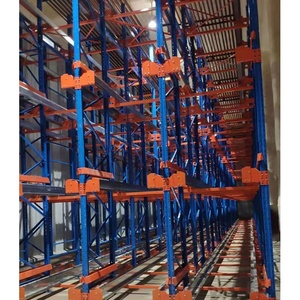
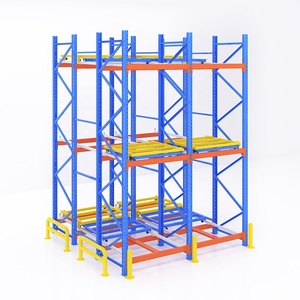
Flow-through pallet racking consists of stationary structural upright frames supporting dynamic inclined roller beds. Loading occurs at the rear (higher elevation) pick-face, while retrieval is handled at the front (lower elevation) discharge face. This physical separation of loading and unloading traffic eliminates forklift congestion and significantly reduces operator travel time within aisles.
To ensure safe, controlled movement across deep-lane configurations (ranging from 4 to 20 pallets deep), our engineering team integrates three essential mechanical components:
Magnetic Speed Controllers
Self-energizing centrifugal or magnetic brake rollers installed at regular pitch intervals maintain pallet travel speeds below 0.3 m/s, preventing dangerous runaway acceleration regardless of pallet weight variance (200kg to 1500kg per position).
Rocker Safety Separators
Located at the discharge end, mechanical pallet separators physically lock back the rest of the lane when the front pallet is being lifted by a forklift. This removes line pressure on the front pallet, allowing smooth, drag-free extraction.
Custom Roller Track Configurations
Available in full-width steel rollers or heavy-duty dual/triple split-track polycarbonate wheels, optimized specifically for standard GMA (40x48 in), Europallets (800x1200 mm), or regional wooden/plastic slip-jack formats utilized across Central America.
Deploying Flow-Through Racking in Turrialba & Cartago Region
Customizing industrial storage systems to match the topography, agricultural demands, and climate of Costa Rica’s central eastern corridor.
Located strategically along Route 10 and linked directly to the Atlantic port corridor via Limón (Moín Container Terminal), Turrialba has evolved into a vital crossroads for Costa Rica's export-oriented agro-industry, specialty coffee processing, dairy operations, and expanding high-tech manufacturing parks. Implementing heavy-duty flow-through pallet racking in this specific geographical region requires deep localization:
Dairy & Agro-Export Cold Storage
Turrialba’s renowned cheese-making and dairy operations, alongside tropical fruit exporters, demand sub-zero temperature integrity. Our flow-through rack systems feature low-temperature synthetic lubricants inside sealed bearings (-30°C certified), maximizing cold room volume efficiency by eliminating redundant access aisles.
Specialty Coffee Dry Mill Batching
Local coffee micro-mills and export staging facilities utilize deep-lane pallet flow systems to manage green bean bag shipments by harvest lot and parchment certification. The strict FIFO dynamic guarantees that earlier harvested lots are automatically funneled to shipping bays first without manual reshuffling.
Medical Device FTZ Assembly Kitting
For industrial parks expanding across Cartago province, carton-flow and pallet-flow modules integrated into cleanroom-adjacent warehouses provide seamless batch feeding of raw polymer components, maintaining strict lot traceabilities required by international ISO standards.
High-Density Storage System Engineering Specifications
Compare performance parameters to determine the optimal dynamic storage architecture for your building footprint.
| Storage System Type | Stock Rotation Method | Floor Space Utilization | Selectivity Rate | Ideal SKU Profile | Seismic Resistance Index |
|---|---|---|---|---|---|
| Flow-Through Pallet Rack | Strict FIFO (First-In, First-Out) | 80% – 85% | Per Lane (High Volume) | High Volume, Fast Moving, Perishable | High (RMI / CSCR Sized) |
| Push-Back Pallet Rack | LIFO (Last-In, First-Out) | 70% – 75% | Per Face Lane | Medium Volume, Multiple SKUs | High (Nested Carts) |
| Drive-In / Drive-Thru | LIFO / FIFO Option | 75% – 80% | Low (Block Storage) | Low SKU Count, Cold Storage Lots | Medium (Requires Top Bracing) |
| Standard Selective Rack | Any (Random Access) | 35% – 40% | 100% Direct Access | High SKU Variety, Low Pallet/SKU | Standard (Single Deep) |
| Radio Shuttle System | Programmable FIFO/LIFO | 85% – 90% | Automated Channel Access | Massive Storage, Automated Hubs | High (Rigid Structural Rails) |
2. Seismic Compliance Under Código Sísmico de Costa Rica (CSCR)
Costa Rica is located along the highly active Circum-Pacific belt, subjecting commercial structures to high spectral acceleration during seismic events. In Turrialba, structural steel racking must be engineered to withstand severe lateral force vectors without frame warping, upright bucking, or pallet dislodgement.
Our manufacturing plant custom-engineers high-tensile structural steel racking utilizing cold-rolled structural steel (Q235B and Q355B grades) adhering strictly to ANSI MH16.1 specifications. Key structural seismic safeguards include:
- Over-Sized Heavy-Duty Base Plates: Thick seismic footplates designed to distribute concentrated leg loads across concrete slabs, featuring multiple anchor holes to ensure embedment depth standards are fully met.
- Moment-Resisting Beam Connectors: Multi-prong heavy-gauge structural connectors with mechanical safety locks that prevent accidental disengagement caused by vertical ground acceleration waves.
- X-Braced Tower Structures & Structural Top Tie-Beams: Rigid cross-bracing frameworks engineered to absorb horizontal shear loads and redirect dynamic forces into the concrete foundation.
Sourcing Racking Systems Direct from China to Turrialba
Navigating shipping corridors, corrosion control, and seamless installation logistics from factory floor to Costa Rica.
Direct ocean procurement from our specialized manufacturing plants in China presents a massive capital expenditure advantage for Costa Rican enterprises, delivering cost savings of 25% to 40% compared to local middleman distributions. However, successful execution requires addressing environmental and logistics variables:
1. Climate-Proofing: Advanced Powder Coat Protection
Turrialba experiences a humid tropical highland climate, with relative atmospheric humidity frequently exceeding 80%. Standard liquid paint finishes degrade rapidly in humid microclimates, leading to sub-surface rust that compromises structural safety.
Our state-of-the-art automated manufacturing facilities utilize multi-stage chemical pre-treatment (iron phosphate wash and deionized rinse) followed by electrostatic dry epoxy powder coating. The components are heat-cured at 200°C, forming an impenetrable, uniform barrier against salt air corrosion, ambient moisture, and mechanical scuffing from forklift contact.
2. Port-to-Site Transit via Moín Container Terminal
Shipments originating from our main China production ports (Shanghai/Ningbo) travel via direct maritime routes to JAPDEVA / APM Terminals in Moín, Limón. From the port, heavy flatbed container transport moves directly along Route 32 and Route 10 into Turrialba, minimizing inland freight expenditure compared to Pacific port arrivals.
70-Year Engineering Lineage
Our manufacturing heritage spans nearly seven decades of structural engineering excellence, guaranteeing fully certified load ratings and strict quality control on every cold-formed profile.
Bolt-On Upright Repair Kits
Accidental forklift impact? Our modular rack repair kits allow plant engineers to repair damaged bottom upright sections in place without disassembling the entire rack bay structure.
Mobile Rack Warrior Digital Tools
Clients gain access to our proprietary mobile engineering calculators, empowering on-site logistics managers to quickly verify upright frame capacities and beam deflection limits instantly.
Frequently Asked Questions for Turrialba Logistics Managers
Clear engineering and commercial answers to simplify your warehouse expansion planning.
Why choose a Flow-Through Pallet Racking system for Turrialba facilities over standard selective racking?
Flow-through pallet racking increases space utilization by 60% by eliminating interior aisle spaces, consolidating storage into dense dynamic lanes. For operations in Turrialba—where cold storage energy cost and real estate footprint expansion must be controlled—flow-through systems maximize cube density while automatically enforcing First-In, First-Out (FIFO) stock rotation for agricultural products, dairy, and food products.
How do your Chinese manufacturing facilities ensure compliance with Costa Rica's seismic codes?
Our engineering team designs every racking system using finite element analysis (FEA) compliant with RMI (ANSI MH16.1) international design practices. We coordinate directly with local CFIA-registered structural engineers in Costa Rica to provide dynamic load calculations matching the seismic acceleration zone parameters established under the Código Sísmico de Costa Rica (CSCR), ensuring baseplate anchors and upright bracing withstand regional earth movements.
What pallet quality and specifications are required for gravity pallet flow lanes?
Gravity flow lanes rely on consistent physical contact between the bottom pallet runners and the lane rollers. Wooden standard GMA (40x48 in) pallets, plastic slip pallets, or Europallets with intact bottom boards operate seamlessly. For damaged or warped wooden pallets, we design specialized full-width steel roller tracks or triple-track wheel configurations to prevent tracking deviation.
How are shipments delivered from China to facilities in Turrialba?
Racking components are professionally bundled, ocean-packed, and shipped in 40ft High Cube (HQ) container vessels from Chinese ports to Moín Port (Limón). From Moín, flatbed trailers transport the containerized cargo inland via Highway 10 directly to your plant in Turrialba. Our export management team handles complete shipping documentation, bill of lading (BOL), and HS code classifications.
How does the tropical highland climate affect racking finish longevity?
Turrialba’s high ambient humidity can trigger rust on poorly finished steel. We apply an industrial-grade electrostatic epoxy powder coat finish cured at 200°C over chemically pre-treated steel. This produces a durable, scratch-resistant barrier that protects structural uprights and beams against atmospheric oxidation and moisture decay for decades.
What design inputs are required to receive a customized rack quotation and CAD drawing?
To generate an accurate engineering proposal, we require: (1) Building floor layout drawing showing clear height, column locations, and door access; (2) Pallet dimensions including load height and gross weight; (3) Required pallet position capacity; (4) Operating environmental temperature (ambient vs cold storage); and (5) Forklift model specs and maximum reach height.
Transform Your Warehouse Efficiency in Turrialba
Connect with our senior engineering team to receive a complimentary custom CAD layout design, structural load analysis, and direct factory pricing quote for your upcoming facility expansion.
Inquire Now