Direct-from-Factory Industrial Storage Systems
Engineered for Maximum Load Integrity, Seismic Resilience, and High-Throughput Warehouse Distribution
Industrial Manufacturing Capabilities & OEM/ODM Excellence
Why Tier-1 Global Logistics Operators and Wholesale Distributors Partner With Our Chinese Manufacturing Facilities
High-Grade Metallurgical Selection
We source certified prime cold-rolled steel (Q235B and Q355B structural grades). Our steel profiles exhibit superior yield strength, preventing premature elastic deformation under extreme vertical pallet pressures.
Automated Powder Coating Lines
State-of-the-art multi-stage wash, degreasing, and automated electrostatic thermosetting powder coating lines ensure a uniform 60–80 micron protective barrier against humidity, abrasion, and salt corrosion.
Seismic Engineering & FEA Design
Our structural design engineering team utilizes advanced Finite Element Analysis (FEA) to simulate complex stress points, dynamic seismic forces (RMI / ANSI MH16.1), and deflection ratios under peak load capacity.
Robotic Precision Welding
AWS-certified robotic welding stations guarantee 100% seam penetration across beam end-connectors and upright base plates, completely eliminating manual welding inconsistency and shear line weakness.
Custom OEM / ODM Configuration
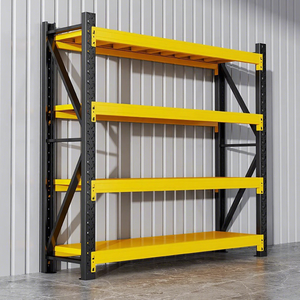
From custom beam lengths and specialized teardrop upright shapes to custom RAL powder paint matching, we provide bespoke manufacturing tailored to unique client distribution specs.
Container Shipping Optimization
Custom heavy-duty bundling and steel pallet packaging designed specifically for ocean container transport maximizes volumetric space while preventing transit scuffing or mechanical damage.
Industrial Racking System Selection Matrix
Technical Comparison of Storage Systems Manufactured in Our China Facilities
Comprehensive Technical Whitepaper: Sourcing Heavy-Duty Industrial Shelving from China
In modern global supply chain management, selecting the appropriate industrial shelving and pallet racking system is a critical engineering decision that directly impacts operational safety, storage efficiency, and capital expenditure ROI. China has evolved into the dominant global manufacturing hub for industrial storage equipment, leveraging integrated steel supply chains, cutting-edge automated roll-forming technologies, and stringent international compliance frameworks.
Information Gain Insight: Sourcing industrial shelving requires rigorous verification of steel yield strength ($f_y$), section modulus ($Z$), load deflection ratios ($L/240$), and certified powder coat salt spray resistance (ISO 9227). Simply comparing price per kilogram leads to structural risk and compromised safety margins under heavy operational strain.
1. Metallurgical Engineering: Cold-Rolled Q235B vs. Q355B Structural Steel
The structural load rating of any warehouse storage system depends heavily on the chemical composition and mechanical properties of the underlying raw steel coil. Premier Chinese manufacturers rely on standard grades Q235B (yield strength $\ge 235 \text{ MPa}$) and Q355B (yield strength $\ge 355 \text{ MPa}$, equivalent to European S355 and US ASTM A572 Grade 50).
- Elasticity and Deflection Limits: Under ANSI MH16.1 standards, horizontal load beams must be designed so that maximum vertical deflection under full design load does not exceed $L/240$ (where $L$ is the clear span length between upright columns).
- Cold-Roll Formed Profiles: Cold-forming increases the yield strength of the steel in the corner bends through work hardening. Our upright posts feature continuous multi-stage cold-roll profiling with up to 14 deformation passes, yielding maximum torsional stiffness and resistance to local buckling.
- Structural Channel Racking: For harsh forklift impact environments (e.g., freezer warehouses, busy distribution hubs), heavy structural hot-rolled channels offer high impact resistance compared to standard gauge roll-formed steel.
2. Surface Treatment Technologies: Corrosion Mitigation & Environmental Factors
Industrial storage systems operate in diverse environmental conditions—ranging from climate-controlled medical warehouses to high-humidity coastal free trade zones and sub-zero cold storage units. Corrosion protection is vital to maintaining structural load ratings across decades of service.
Our manufacturing facilities utilize a 7-stage automated surface conversion process:
- Hot Alkaline Degreasing: Removes residual rolling oils and mill lubricants.
- Water Rinsing & Surface Conditioning: Prepares metal surfaces for uniform crystal formation.
- Zinc Phosphate Conversion Coating: Creates a micro-crystalline layer enhancing paint adhesion and preventing lateral corrosion creep.
- Deionized Water Rinse: Eliminates ionic contaminants.
- Electrostatic Powder Application: Thermosetting epoxy-polyester hybrid powders are applied electrostatically at 60–80 kV to achieve an even thickness of 60 to 80 microns.
- High-Temperature Curing Tunnel: Baked at 180°C – 200°C for 20 minutes to cross-link polymer chains, producing a scratch-resistant, impact-resistant finish.
- Hot-Dip Galvanizing (Optional): For extreme coastal outdoor exposure or wash-down facilities, structural components undergo hot-dip galvanization per ASTM A123, delivering a zinc coating thickness exceeding 85 microns.
3. Global Structural Standards & Seismic Design Considerations
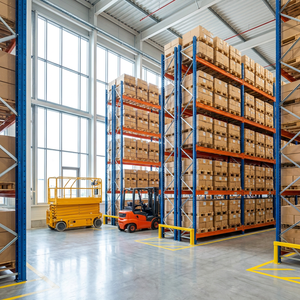
Industrial storage racks are freestanding engineered structures subject to static dead loads, dynamic live loads during forklift placement, and lateral seismic accelerations. Leading Chinese export manufacturers engineer systems fully aligned with global engineering codes:
- RMI (Rack Manufacturers Institute) / ANSI MH16.1: Specification for the Design, Testing, and Utilization of Industrial Steel Storage Racks.
- FEM 10.2.02 / EN 15512: European code governing cold-formed steel static racking design.
- Seismic Engineering & Anchoring: Base plate footprint sizes, anchor bolt embedment depth, and upright frame bracing geometry are calculated based on site-specific ground acceleration parameters ($S_s, S_1$). Seismic base plates utilize heavy-gauge hot-rolled steel plate to distribute moment forces safely into the concrete floor slab.
Safety Precaution: Modifying beam elevation spacing without re-calculating upright capacity fundamentally alters the unsupported frame length ($K L/r$), significantly reducing total load capacity per bay. Always consult factory engineering load tables before reconfiguring shelf levels.
Future Procurement & Technology Trends (2025–2030)
Key Innovations Shaping Global Industrial Warehouse Shelving Manufacturing
AS/RS & Automated Shuttle Integration
Storage systems are rapidly shifting from manual forklift loading to ultra-precise automated rack structures engineered for Radio Shuttle carts, AGVs, and high-speed AS/RS crane systems with millimeter-level tolerances.
Eco-Friendly & Low-Carbon Green Steel
In response to global Scope 3 carbon emission standards, advanced Chinese steel mills are utilizing electric arc furnace (EAF) green steel production, reducing the embodied carbon footprint of warehouse racking systems by up to 40%.
Modular Boltless Rapid Deployment
E-commerce fulfillment centers demand rapid scalability. Next-generation boltless industrial shelving features tool-free clip connectors, allowing rapid height adjustability and effortless bay expansion without structural downtime.
Frequently Asked Technical Questions (FAQ)
Answers to Common Engineering, Sourcing, and Customs Questions for International Buyers
What steel standards are used by industrial shelving manufacturers in China?
Leading manufacturers utilize certified prime structural steel conforming to Chinese National Standard GB/T 700 (Q235B grade) and GB/T 1591 (Q355B grade). These structural steels correspond directly to European EN 10025 (S235JR and S355JR) and US ASTM standards (ASTM A36 and ASTM A572 Grade 50), offering predictable yield strength and structural ductility under heavy loads.
How do you ensure safe pallet rack structural capacities?
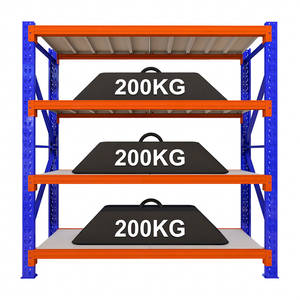
Racking structural capacity is determined using Finite Element Analysis (FEA) computer modeling combined with destructive physical testing under RMI / ANSI MH16.1 guidelines. Load capacities include a minimum ultimate safety factor of 1.65 to 1.9 relative to the steel yield point, ensuring structural stability under maximum stated capacity limits.
Can Chinese shelving manufacturers customize sizes, colors, and racking profiles?
Yes, comprehensive OEM/ODM manufacturing is a primary competitive advantage. Upright column pitches, beam lengths, depth dimensions, powder coat RAL colors, and specialized accessories (such as wire mesh decking, pallet support bars, and column protectors) can be custom-engineered to match specific warehouse layouts.
What surface finish performs best in cold storage and high-humidity environments?
For standard climate-controlled warehouses, high-durability electrostatic powder coating (60–80 microns) provides long-lasting anti-scratch protection. For sub-zero cold storage facilities with condensation cycles, or outdoor environments, pre-galvanized steel sheet or hot-dip galvanizing (ASTM A123) is recommended to eliminate surface rusting.
How are heavy industrial racking systems packaged for ocean freight shipping?
Upright frames and beams are nested, banded with heavy-duty steel strapping, and fitted with protective cardboard corner guards and wooden timber skids. Loose components such as connectors, base plates, and hardware are packaged in reinforced corrugated cartons or wooden crates to streamline container unloading via forklift.
Can damaged racking uprights be repaired without dismantling the entire system?
Yes. Engineered bolt-on rack repair kits allow damaged lower column sections to be safely cut out and replaced with heavy-duty structural steel inserts, fully restoring original frame capacity without requiring complete disassembly of upper shelf levels.