Engineering Catalog
High-Performance Storage Racking Systems
Explore our export-certified industrial racking solutions engineered for high load capacity, structural stability, and maximum spatial efficiency.
Manufacturing Excellence
Why Tier-1 Global Procurement Teams Partner With Us
Combining structural metallurgy, automated manufacturing, and rigorous international quality control to safeguard your supply chain investments.
High-Yield Steel Cold-Forming
We source certified Q235B and high-tensile Q355B cold-rolled structural steel from premier state mills. Advanced multi-stage continuous roll-forming lines guarantee rigid upright profiles with minimal residual structural stress and tight dimensional tolerances.
Automated Powder Coating Line
Components undergo an 8-stage pre-treatment wash including automatic zirc-phosphating before electrostatic thermosetting epoxy-polyester powder application. This achieves a 60–90 micron uniform barrier resistant to salt spray, humidity, and mechanical abrasion.
Seismic & Structural Calculations
Every longspan system is calculated in adherence to ANSI MH16.1 (RMI) and EN 15512 guidelines. We deliver tailored structural calculations verifying base plate anchor embedment depth, slab shear strength, and dynamic response factors under seismic loads.
Engineering Whitepaper: Structural Architecture of Industrial Longspan Racking
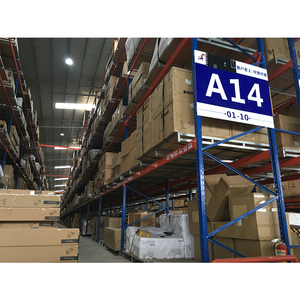
Modern warehouse logistics requires a bridge between lightweight boltless shelving and heavy-duty selective pallet racking. Heavy-Duty Longspan Racking represents the optimal engineering balance for manual or semi-automated carton picking, archive storage, non-standard component handling, and high-density industrial storage. As a leading manufacturer and exporter in China, our structural designs focus on maximizing load-to-weight ratios while providing absolute structural resilience under dynamic operational environments.
1. Column Profile Geometry & Upright Frame Mechanics
The structural load integrity of a longspan racking system is fundamentally governed by upright column cross-section profile geometry. Unlike low-tier folded sheet metal shelving, industrial-grade longspan systems utilize cold-rolled steel columns engineered with multiple stiffening ribs along the web and flanges. Standard upright profiles range from 55×47mm and 60×50mm for medium loads up to 80×60mm and 90×70mm heavy-duty columns with material thickness between 1.5mm and 2.5mm.
Frames are assembled using diagonal and horizontal structural bracing connected via high-tensile Grade 8.8 bolts. This lattice design dissipates lateral sway forces across the entire frame assembly, allowing high-bay installations of up to 8 meters without compromising localized buckling margins.
2. Beam Profile Dynamics & Connection Safety Locks
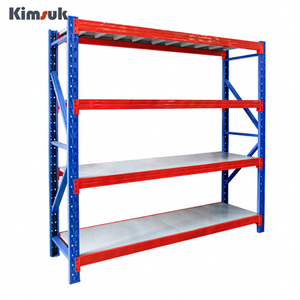
Longspan racking beams are designed primarily as step beams or tubular P-beams to accommodate recessed steel panels, wire mesh decks, or timber boards flush with the top beam flange. Beam connectors feature 3-hook or 4-hook heavy-gauge cold-stamped connector brackets that wrap around the upright profile.
Engineering Standard: All beam-to-column connections feature automatic safety locks (drop-out safety pins) engineered to withstand minimum uplift forces of 5 kN per connection as required by ANSI MH16.1 specifications, preventing accidental beam displacement during forklift operation or hand-loading impact.
System Specification Reference Matrix
| Rack Type / Profile | Typical Load Capacity | Material Specification | Surface Treatment | Compliance Standards |
|---|---|---|---|---|
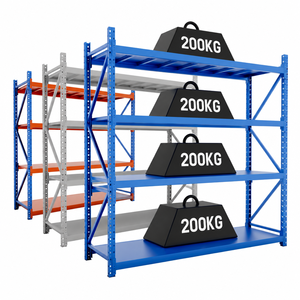
| Light-Medium Longspan | 100kg – 300kg / level | Q235B Cold-Rolled Steel | Thermosetting Powder Coat (60µm) | ISO 9001, CE Mark |
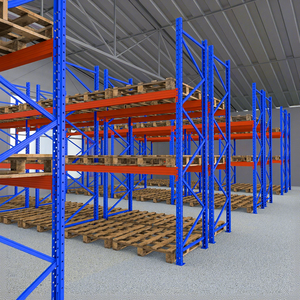
| Heavy-Duty Industrial Longspan | 500kg – 1,000kg / level | High-Yield Q235B / Q355B | Automated Epoxy Powder Coating | RMI (ANSI MH16.1), EN 15512 |
| Mobile Cantilever & Pipe Rack | 800kg – 2,500kg / arm | Hot-Rolled Structural I-Beam / H-Section | Galvanized / Anti-Corrosion Coating | AS 4084, FEM 10.2.02 |
| Cold Storage Longspan Systems | 500kg – 1,500kg / level | Low-Temperature Carbon Steel | Hot-Dip Galvanized (ISO 1461) | EN 15635, ASTM A123 |
3. Deflection Metrics & Safety Factors
Under peak structural loading, beam deflection is engineered to strictly observe the maximum allowable limits defined by international storage codes. The maximum horizontal beam deflection under full uniformly distributed load (UDL) does not exceed L/200 for standard applications, and L/240 for high-precision or automated interface installations. Structural yield safety factors are maintained between 1.65 and 2.0 based on material stress thresholds, ensuring structural endurance against dynamic load shocks.
Global Procurement Trends in Warehouse Storage Systems (2025–2030)
The international warehousing and material handling market is undergoing structural shifts driven by global e-commerce maturation, nearshoring supply chain realignment, and stringent ESG (Environmental, Social, and Governance) compliance mandates. Enterprise procurement directors evaluating racking suppliers in China are expanding their criteria beyond basic unit cost per shelf.
1. Demand for Modular Hybrid Racking
Modern distribution centers no longer rely on single-purpose storage configurations. Global procurement demands modular systems capable of converting longspan hand-pick shelves into multi-tier mezzanines or integrating carton flow tracks. Systems must easily adapt to changing SKU dimensions without requiring structural cutting or field welding.
2. Total Cost of Ownership (TCO) Prioritization
Procurement teams are shifting focus from initial CapEx to TCO. Advanced surface anti-corrosion treatments, robotic weld integrity, and impact-resistant upright guards reduce long-term maintenance costs and prevent operational downtime caused by structural upright replacements.
3. ESG Compliance & Decarbonized Manufacturing
European and North American buyers increasingly evaluate the carbon footprint of structural steel fabrication. Leading Chinese manufacturers are investing in solar-powered production facilities, energy-efficient powder curing ovens, and closed-loop water recovery systems during chemical pretreatments, ensuring complete alignment with global ESG reporting standard mandates.
Future Technological Directions in Industrial Racking Systems
As logistics facilities transition toward Industry 4.0 automation, physical storage racking is evolving from passive steel frameworks into intelligent, connected structural assets.
1. Smart Racking & Embedded IoT Load Monitoring
Next-generation longspan and pallet racking configurations incorporate embedded strain-gauge sensor nodes and micro-tilt meters directly into critical beam connections and baseplates. These IoT sensors continuously stream stress, vibration, and deflection telemetry to cloud-based Warehouse Management Systems (WMS), issuing real-time safety alerts prior to catastrophic structural failures or dynamic forklift impacts.
2. Seamless Integration with AMR & AGV Robotics
The acceleration of Autonomous Mobile Robots (AMRs) and Automated Guided Vehicles (AGVs) requires structural racking with ultra-precise manufacturing tolerances. Frame verticality, beam deflection profiles, and aisle clearance margins must be held to millimeter-level accuracy to allow robotic grippers and automated shuttle platforms to execute high-speed picking without mechanical jamming.
3. Eco-Friendly Powder Chemistry & Nanotechnology Coatings
Future surface technology moves toward non-VOC, heavy-metal-free powder chemistries enriched with graphene oxide or nanoceramic additives. These advanced coatings provide double the scratch resistance and salt-fog endurance while applying thinner coat layers, reducing material raw input consumption while enhancing life-cycle performance in harsh cold-chain or humid tropical logistics hubs.
Technical Support
Frequently Asked Questions for Industrial Procurement
In-depth engineering answers covering technical standards, customization options, seismic considerations, and international export logistics.
What parameters are required to generate a certified racking engineering design?
To provide an accurate, code-compliant structural calculation and layout, our engineering team requires: (1) Pallet or carton dimensions (Length × Width × Height), (2) Maximum and average load weights per level, (3) Building clear ceiling height, (4) Concrete floor slab thickness and compressive strength (f'c rating), (5) Forklift model, turning radius, and maximum lift height, and (6) Environmental operating conditions (e.g., ambient warehouse, cold room -30°C, or coastal high-humidity zone).
How do you verify structural integrity under seismic activity?
We perform Finite Element Analysis (FEA) modeling based on local seismic zone acceleration coefficients (Ss and S1) according to RMI / ANSI MH16.1, EN 15512, or regional codes like the Código Sísmico de Costa Rica (CSCR). Baseplate dimensions, anchor bolt diameters, and embedment depths are calculated specifically to resist lateral overturning moments and shear forces experienced during seismic events.
What is the technical difference between Q235B and Q355B structural steel grades?
Q235B is a standard carbon structural steel with a yield strength of 235 MPa, ideal for general-purpose beams and medium-duty longspan shelving. Q355B is a low-alloy high-strength steel with a yield strength of 355 MPa. Using Q355B for upright columns and heavy-duty beams allows a 15%–25% reduction in material weight while maintaining identical or superior structural load capacity, significantly reducing international ocean freight costs.
Which surface finish is recommended for high-humidity or cold-room facilities?
For standard dry indoor warehouses, high-durability electrostatic epoxy-polyester powder coating (60–90 µm thickness) provides superior chemical and scratch resistance. For cold storage (-30°C), wash-down zones, or outdoor/coastal sites exposed to ocean salt air, we recommend Hot-Dip Galvanizing (HDG) per ISO 1461 / ASTM A123, which coats both interior and exterior surfaces with a protective zinc barrier layer (60–100 µm zinc thickness).
Can your longspan racking systems be integrated with multi-tier mezzanine floors?
Yes. Our heavy-duty longspan racking frames are engineered to serve as the structural support columns for multi-tier mezzanine walkways. By utilizing high-capacity upright profiles (80×60mm or 90×70mm) and engineered floor joists, vertical warehouse cube space can be doubled or tripled for manual order picking without requiring structural building modifications.
What quality control certifications and mill test reports do you provide?
Every shipment is accompanied by Mill Test Certificates (MTC) verifying raw material chemical composition and mechanical yield testing under EN 10204 3.1 standards. In addition, we supply factory quality inspection reports covering weld NDT (non-destructive testing), powder coating cross-hatch adhesion test results, coating thickness measurement logs, and ISO 9001 / CE compliance certificates.
How are export container shipments packed to prevent transit damage?
All upright frames and beams are bundled using heavy-duty steel banding, protective corrugated cardboard corner guards, and plastic stretch film wrapping. Small hardware components, baseplates, and safety pins are packed in reinforced wooden crates or heavy-gauge corrugated cartons. Bundles are configured with custom timber skids to facilitate rapid unloading using standard forklifts at port destinations.