Heavy-Duty Warehouse Storage Solutions
Executive Summary: Navigating China's Pallet Racking & Shelving Supply Chain
In modern industrial logistics, storage efficiency directly impacts bottom-line profitability. As global supply chains scale and warehouse land costs surge, selecting qualified China best pallet racking and shelving suppliers & wholesalers has evolved from a simple purchasing decision into a critical structural engineering endeavor. China accounts for over 45% of the world's structural rack steel fabrication, driven by advanced cold-roll forming lines, automated robotic welding, and an integrated supply chain for certified steel coil.
However, navigating the supplier landscape requires deep technical discernment. B2B procurement managers must evaluate suppliers beyond superficial unit costs, analyzing yield strength metrics ($f_y$), cold-formed structural integrity, electrostatic powder-coating thickness, and seismic spectral resistance. This comprehensive industry whitepaper breaks down manufacturing methodologies, structural physics, procurement strategies, and technical trends to guide logistics directors, warehouse engineers, and B2B buyers toward optimal storage infrastructure investments.
Enterprise Manufacturing Heritage & Structural Engineering Excellence
Superior industrial racking systems begin at the metallurgical level. Top-tier Chinese manufacturers utilize prime structural steel grades—primarily Q235B and Q355B (equivalent to ASTM A36 and ASTM A572 Grade 50 respectively). The structural behavior of upright frames and load beams depends on precise cold-roll forming, where coil steel is incrementally shaped through multi-stage roller dies to avoid internal residual stresses and micro-fractures.
Certified Material Integrity
Every batch of structural coil undergoes mill test verification (EN 10204 3.1) to guarantee yield strength exceeding 355 MPa, preventing unexpected beam deflection under dynamic loads.
Seismic Finite Element Analysis
Advanced FEA engineering simulates static, dynamic, and seismic forces (complying with FEM 10.2.08 and ANSI MH16.1), ensuring frame stability in earthquake-prone zones.
Automated Surface Finishing
Multi-stage pre-treatment wash coupled with automated electrostatic epoxy powder coating yields a durable 60–80 micron finish resistant to impact, chemical exposure, and humidity.
Quality assurance protocols at leading Chinese production facilities encompass non-destructive testing (NDT) on robotic weld joints, ultrasonic thickness gauging, and destructive load testing to failure. By maintaining absolute control over column pitch perforations (typically 50mm or 75mm pattern pitch), structural tolerances are constrained within tight limits ($\pm 0.5 \text{ mm}$ over 10 meters of upright length), facilitating rapid on-site assembly and complete component interchangeability.
Engineering Deep-Dive: Material Specifications & Load Physics
Understanding the mechanical trade-offs between system types is paramount when designing high-bay or dense warehouse layouts. The table below outlines key structural parameters across primary industrial racking configurations offered by leading Chinese manufacturers:
| Racking Architecture | Primary Steel Grade | Max Load Capacity / Level | Deflection Limit ($\Delta$) | Ideal Application / Industry |
|---|---|---|---|---|
| Heavy-Duty Selective Pallet Rack | Q235B / Q355B Cold-Rolled | 1,000 kg – 4,500 kg | $L / 200$ | General Distribution, FMCG, 3PL Warehousing |
| Automated Radio Shuttle System | Q355B High-Tensile | 1,500 kg per pallet lane | $L / 300$ (Precision Rail) | Cold Storage, Food & Beverage, Bulk Chemical |
| Drive-In / Drive-Thru Racking | Q235B Structural Profile | 1,000 kg – 2,000 kg | $L / 250$ | High-Volume, Low-SKU Uniform Cargo |
| Galvanized Sheet Metal Shelving | Pre-Galvanized DX51D+Z | 300 kg – 800 kg | $L / 180$ | Pharmaceuticals, Cleanrooms, Humidity Zones |
| Heavy-Duty Boltless Steel Shelving | Q235B Cold-Formed Steel | 500 kg – 1,200 kg | $L / 200$ | E-commerce Split-Case, Auto Spare Parts |
Product Technical Analysis: In-Depth Breakdown
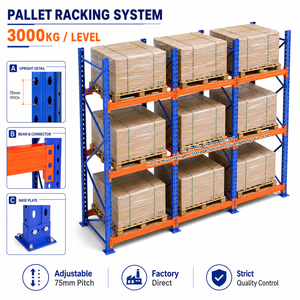
1. Selective Pallet Racking Systems (3000KG Class)
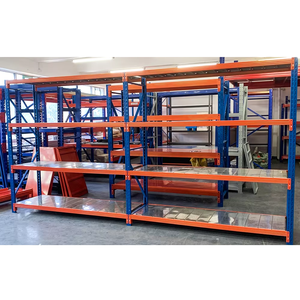
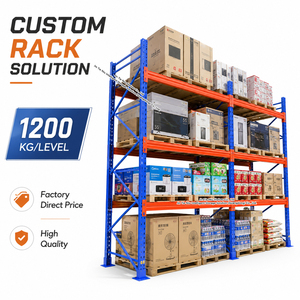
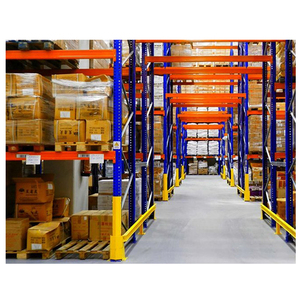
Selective pallet racking remains the backbone of global warehouse operations due to its 100% direct pallet accessibility. Manufactured using roll-formed C-section columns connected by heavy-duty bracing tubes, these systems utilize 3-claw or 4-molded claw beam connectors with mechanical safety pins to prevent accidental dislodgement. The structural beam profile typically features a box-beam or step-beam cross-section engineered to maintain vertical deflection below $L/200$ under full static load.
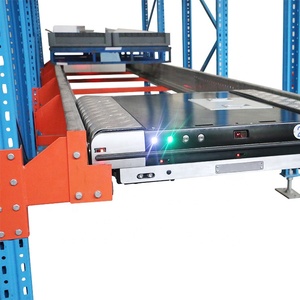
2. Automated Radio Shuttle High-Density Systems
Designed for cold-chain storage and high-throughput raw material facilities, automated pallet shuttle systems maximize floor cube utilization by eliminating traditional fork-truck access aisles. Powered by lithium-iron-phosphate ($LiFePO_4$) batteries, remote-controlled shuttle cars travel along specialized cold-rolled guide rails to deposit and retrieve pallets in either FIFO (First-In, First-Out) or FILO (First-In, Last-Out) modes. Precision manufacturing ensures rail levelness within $\pm 1.5\text{ mm}$ across 50-meter deep channels.
3. Galvanized & Boltless Industrial Steel Shelving
For manual fulfillment, e-commerce picking, and harsh environmental conditions, hot-dip galvanized or pre-galvanized sheet metal shelving provides exceptional anti-corrosion performance (rated for C3 to C5-I industrial atmospheric conditions). Boltless connection mechanisms utilize teardrop or butterfly slot designs, drastically cutting installation labor hours while offering flexible shelf height adjustability without requiring specialized tooling.
Future Sourcing & Procurement Trends in Industrial Storage
The global industrial storage market is undergoing rapid technology-driven transformation. Sourcing professionals evaluating Chinese suppliers must position their procurement strategies to align with three primary future trends:
1. Integration with AS/RS & AGV Infrastructure
Traditional static racking is increasingly giving way to AS/RS (Automated Storage and Retrieval Systems) and Autonomous Mobile Robot (AMR) compatible racks. Procurement specifications now mandate millimeter-level tolerances, integrated sensor mounting brackets, and specialized floor-anchoring baseplates.
2. Total Cost of Ownership (TCO) & Freight Optimization
With global container freight rates fluctuating, premier Chinese manufacturers design modular "Knock-Down" (KD) structural components. By nesting upright frames and utilizing optimized beam stacking configurations, sea freight container cube loading efficiency is improved by up to 35%.
3. Sustainable Carbon-Audited Steel Production
Environmental ESG compliance is becoming mandatory. Top Chinese vendors are transitioning to green steel coils processed using scrap-based Electric Arc Furnaces (EAF) and low-VOC powder coatings, accompanied by carbon footprint verification reports.
Comprehensive B2B Procurement FAQ
Below are critical technical questions asked by structural engineers, supply chain directors, and B2B buyers when evaluating Chinese racking and shelving manufacturers:
What steel standards and mill certifications should I require from Chinese racking suppliers?
You should insist on raw material Mill Test Certificates (MTC) conforming to EN 10204 3.1. Standard structural steel should meet GB/T 700 Q235B (equivalent to ASTM A36) or GB/T 1591 Q355B (equivalent to ASTM A572 Grade 50). These certificates verify chemical composition (Carbon, Manganese, Silicon content) and mechanical properties including yield strength ($f_y$), ultimate tensile strength ($f_u$), and elongation percentage.
How do Chinese manufacturers guarantee seismic compliance for international building codes?
Reputable suppliers employ specialized structural engineering teams capable of performing Finite Element Analysis (FEA) tailored to localized building standards—such as ANSI/RMI MH16.1 in North America, FEM 10.2.08 in Europe, or AS 4084 in Australia. By inputting specific seismic ground acceleration values ($S_s, S_1$) and floor slab anchor embedment data, frame bracing geometries and baseplate surface areas are engineered to safely dissipate seismic energy.
What is the difference between pre-galvanized, hot-dip galvanized, and powder-coated surface finishes?
Powder Coating provides an economical, impact-resistant finish in various colors, ideal for indoor ambient warehouses. Pre-Galvanized steel utilizes mill-galvanized sheet coils suitable for medium humidity environments and light industrial shelving. Hot-Dip Galvanizing (HDG) involves submerging fabricated steel into molten zinc (ISO 1461), creating a thick 85+ micron coating that offers self-healing cathodic protection mandatory for outdoor use, extreme cold storage, or corrosive chemical environments.
How can I verify the actual load capacity of a racking system prior to shipment?
Load capacity verification requires a two-step approach: First, review third-party structural calculation sheets verified by a certified Professional Engineer (PE). Second, request on-site physical destructive or non-destructive prototype testing according to FEM 10.2.02 standards, measuring mid-span beam deflection under 1.5x full design load to confirm safety factor margins.
What container shipping and packaging protocols prevent shipping damage?
High-quality manufacturers utilize specialized wooden or steel dunnage framing, heavy-duty plastic stretch wrapping, edge corner protectors, and steel strapping. Upright frames are nested, and beam connectors are capped with protective foam to prevent paint abrasion and structural bending during ocean transit across rough seas.
Can customized OEM components be retrofitted to existing racking installations from other brands?
Yes, provided precise engineering site surveys are performed. Chinese manufacturers can custom-punch column hole profiles (such as teardrop, keyhole, or structural bolt patterns) to ensure full mechanical compatibility. However, mixing structural elements from different manufacturers requires engineering re-certification of overall system frame capacities under RMI safety guidelines.
Ready to Optimize Your Warehouse Capacity?
Connect directly with our senior structural engineering team for custom CAD layouts, seismic load calculations, and competitive direct factory pricing.
Contact Us