Featured Cantilever Racking Systems
Explore our CE & RMI-compliant heavy-duty storage engineering systems optimized for profiles, tubing, timber, and heavy industrial loads.
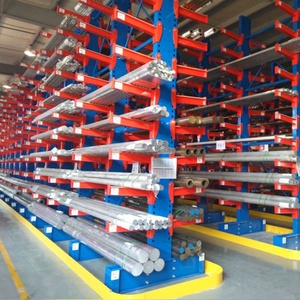
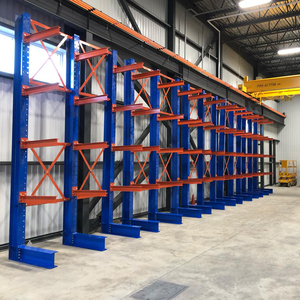
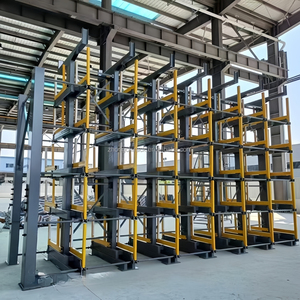
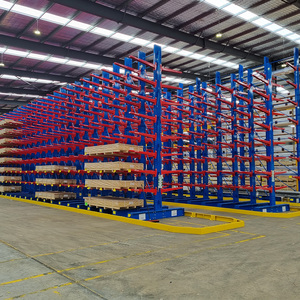
1. Technical Fundamentals of Industrial Cantilever Racking Design
In modern material handling and intra-logistics, storing long, bulky, or non-standard loads such as steel pipes, aluminum extrusions, timber packs, plastic tubing, and heavy sheet metal presents unique structural challenges. Traditional pallet racking systems with front vertical columns introduce spatial obstructions that restrict lateral loading. As a leading manufacturer and direct supplier in China, our heavy-duty cantilever warehouse racking systems are purpose-engineered to eliminate front column interference, offering an uninterrupted horizontal storage plane.
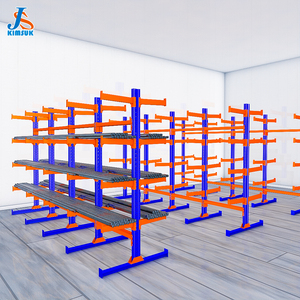
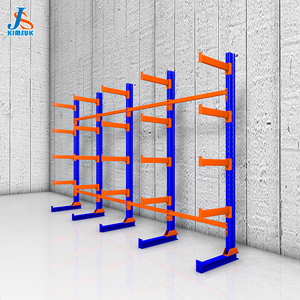
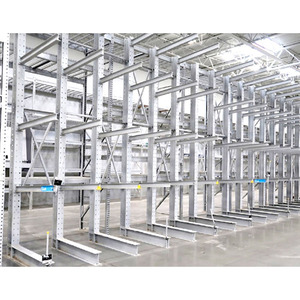
A structural cantilever racking assembly consists of three critical engineering components: vertical columns (uprights), horizontal bases, and extended cantilever arms supported by heavy-duty cross-bracing sets. The fundamental structural principle relies on a single-point connection where load moments are transferred directly from cantilever arms into the central vertical column, generating combined bending and compression stresses ($M + N$).
1.1 Roll-Formed vs. Hot-Rolled Structural Steel Profiles
When evaluating suppliers from China, global procurement directors must differentiate between Roll-Formed Steel Cantilever Racks and Hot-Rolled Structural I-Beam Cantilever Racks based on duty cycle, impact severity, and structural load metrics:
- Roll-Formed Cantilever Racks (Light to Medium-Heavy Duty): Fabricated from high-grade cold-rolled coil steel (typically Q235B or equivalent). These systems utilize C-profile columns and arms with punched keyhole or pin-drop connection configurations. They provide cost-effective solutions for loads up to 1,000 kg per arm, perfect for light tubing, plastic extrusions, and retail home improvement centers.
- Hot-Rolled Structural Cantilever Racks (Heavy Duty to Extra Heavy Duty): Utilizing hot-rolled H-Beams (such as IPE, HEA, or custom Q355B structural sections), these systems are built for demanding industrial environments. Base and column sections are joined using high-strength Grade 8.8 structural bolting. Structural arms can handle loads ranging from 1,500 kg to over 5,000 kg per arm, making them ideal for heavy steel plates, rebar bundles, and raw timber packs.
| Structural Parameter | Light/Medium Duty (Roll-Formed) | Heavy Duty (Structural H-Beam) | Ultra Heavy / Automated Roll-Out |
|---|---|---|---|
| Primary Steel Grade | Q235B (Yield ~235 MPa) | Q355B / Q460 (Yield 355-460 MPa) | Q355B High-Tensile Structural Steel |
| Arm Load Range (Per Arm) | 200 kg – 1,000 kg | 1,000 kg – 3,500 kg | 3,000 kg – 6,000 kg+ |
| Arm Pitch Adjustment | 75mm / 76.2mm (3 inches) | 100mm / 101.6mm (4 inches) | Custom Hydro-Electric / Gear Pitch |
| Standard Column Height | 2,000mm – 6,000mm | 3,000mm – 12,000mm+ | 4,000mm – 9,000mm |
| Surface Finish Options | Powder Coating (Epoxy-Polyester) | Powder Coated / Hot-Dip Galvanized | Duplex Coating (Galvanized + Powder) |
2. Key Innovations in Product Development & Structural Dynamics
As Chinese racking manufacturers advance from traditional fabrication to high-precision engineering, our R&D teams have pioneered several technical breakthroughs designed to maximize warehouse cube utilization, operator safety, and material handling speed.
Roll-Out & Crank-Out Cantilever Systems
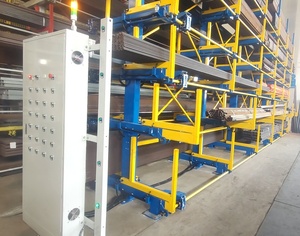
Eliminating overhead crane clearance issues, roll-out cantilever racking utilizes mechanical hand-crank or hydraulic mechanisms to extend arms outward 100%. This allows overhead cranes direct vertical access to heavy steel bars or dies, reducing aisle width demands by up to 50%.
Electric Telescopic Motorized Racks
Engineered for Industry 4.0 automated smart warehouses, push-button or PLC-controlled electric motorized cantilever systems smoothly extend individual storage levels. Integrated with sensor arrays, these units ensure ZERO structural deflection during extension and eliminate manual hand-cranking.
Seismic & Anti-Impact Pivot Arm Joints
To prevent severe column damage from forklift collisions, our proprietary pin-locking arm connection allows cantilever arms to pivot upward and sideways when impacted by an elevating crane or vehicle, absorbing dynamic kinetic energy without permanent shear deformation.
3. Future Procurement Trends in Industrial Cantilever Storage (2025–2030)
Global supply chain leaders face escalating real estate acquisition costs, labor shortages, and stringent environmental ESG compliance. When sourcing cantilever warehouse racking from China suppliers, purchasing teams should account for several key procurement trends transforming the industry:
3.1 High-Density Automated Storage & Retrieval (AS/RS) Integration
The shift from traditional forklift-operated cantilever racking to fully automated AS/RS stacker crane systems is accelerating. Modern heavy-duty cantilever racks feature laser-aligned guidance tracks integrated into column bases, sensor reflectors, and high-precision rack plumb tolerance ($\Delta \le L/1000$). These designs support automated long-goods shuttles capable of picking 6-meter steel bundles autonomously.
3.2 Sustainable Low-Carbon Steel & Eco-Coating Systems
International buyers now require Environmental Product Declarations (EPD) and green supply chain validation. Our manufacturing lines prioritize green steel certified suppliers, utilizing zero-VOC electrostatic epoxy powder coat lines with closed-loop water recycling. This provides high salt-spray resistance (ASTM B117 > 500 hours) while reducing carbon intensity across the manufacturing lifecycle.
3.3 Modular Knock-Down (KD) Shipping Engineering
Ocean freight rates require optimal container volumetric fill rates. Innovations in modular base-to-column splices and detachable arm sockets allow Chinese manufacturers to ship high-capacity cantilever racks flat-packed. This increases 40ft High-Cube container payload efficiency by 35% to 50%, significantly lowering landed cost per storage unit.
Optimize Your Long-Goods Warehouse Layout Today
Work directly with our structural engineering team to receive customized CAD layout drawings, FEA load calculations, and competitive direct factory pricing within 24 hours.
Get Catalog4. Enterprise Manufacturing Capabilities & OEM/ODM Advantages
Choosing the top China cantilever warehouse racking supplier requires rigorous evaluation of factory infrastructure, quality assurance systems, structural testing compliance, and international execution experience.
Advanced Automated CNC Manufacturing
Our production base spans over 50,000 square meters, equipped with high-precision CNC laser pipe cutters, robotic welding cells, continuous cold-roll forming lines, and multi-stage automatic pre-treatment powder coating systems. High-precision laser cutting guarantees structural bolt hole positioning within $\pm 0.2\text{mm}$.
Finite Element Analysis (FEA) Structural Design
Every racking system undergoes computer-simulated Finite Element Analysis (FEA) to verify structural safety under combined bending, torsion, axial loading, and localized buckling. We design strictly to global engineering standards including ANSI MH16.1 (RMI), FEM 10.2.09, and EN 15662.
Strict Quality Control & Load Testing
Raw materials are verified via spectral analysis and tensile yield testing. Welded joints undergo non-destructive ultrasonic testing (NDT), while finished cantilever arms undergo dynamic load-deflection proof tests to guarantee design safety factors ($SF \ge 1.5$ to $1.8$).
Frequently Asked Sourcing & Structural Engineering Questions
Technical insights to help procurement managers and structural consultants select the ideal cantilever system.
Q: How do I determine the correct cantilever arm length and capacity for my specific load?
Arm length must match or slightly exceed the depth of the stored material bundle. The capacity per arm is calculated by taking the total weight of the product bundle and dividing it by the minimum number of arms required to support the load without deflection sag (typically 2 to 4 arms depending on bundle flexibility). Always ensure the load's center of gravity (CG) rests at the midpoint of the cantilever arm.
Q: What is the difference between single-sided and double-sided cantilever racking columns?
Single-sided cantilever racks feature arms extending from only one side of the vertical column, typically installed against warehouse walls. Double-sided racking features arms extending from both the front and rear faces of a single central column. Double-sided systems offer superior structural stability because opposing loads counterbalance moment forces on the central upright, maximizing floor space in central aisles.
Q: What concrete floor slab specifications are required for heavy-duty structural cantilever racks?
Heavy-duty cantilever racks impose high point loads and overturning moment forces on concrete foundations. Standard installations require a reinforced concrete floor slab with a minimum thickness of 150mm to 250mm, featuring a concrete compressive strength rating of at least $C25/C30$ ($30\text{ MPa}$ compressive strength). Heavy structural racks are secured using chemical adhesive anchors or expanding wedge anchor bolts verified for uplift resistance.
Q: Can cantilever racking systems be customized for outdoor storage environments?
Yes. For outdoor environments subject to rain, moisture, or coastal atmospheric corrosion (C3 to C5 corrosive environments), we supply Hot-Dip Galvanized (HDG) cantilever racking complying with ISO 1461 standards. HDG provides a thick zinc-iron alloy coating both inside and outside column profiles, protecting against rust for over 25 years. Roof structural extensions and weather canopies can also be integrated directly into column tops.
Q: What international quality and safety standards do your racking systems comply with?
Our cantilever racking products are engineered and manufactured in strict compliance with ISO 9001 quality management systems, European CE certification standards (EN 1090 / EN 15635), RMI (Rack Manufacturers Institute) specification ANSI MH16.1, and FEM 10.2.09 code guidelines for industrial storage systems. Full mill test certificates (MTC) and FEA test reports are provided with every engineering shipment.
Ready to Upgrade Your Heavy Long-Goods Storage System?
Download our complete technical specifications catalog or request a direct factory consultation with our senior engineering team.
Get Catalog